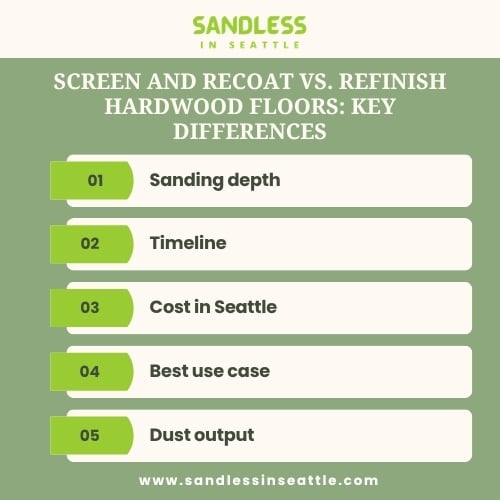
Seattle homeowners know their floors take a beating year-round. Rainy Capitol Hill winters and busy Queen Anne or Eastlake lifestyles give your hardwood floors no break. Muddy boots and constant activity quickly wear down their protective finish.
When floors look flat and tired, most people ask the same question: screen and recoat vs. refinish hardwood floors? Determining which option is actually worth the investment depends on the current state of your hardwood.
Knowing which service your floor actually needs could save you thousands. The answer comes down to your finish condition, not just how the surface looks.
What Is a Screen and Recoat?
A screen and recoat, also known as buff and recoat vs. refinish in the flooring industry, is a surface-level maintenance service.
A technician lightly abrades the existing finish using a rotary buffer fitted with a mesh screen.
They then apply a fresh coat of polyurethane on top.
The wood itself is never touched.
It’s a one-day process that produces minimal dust, making it a smart choice for Seattle homeowners.
This is especially true for those who want visible results without the disruption.
What Is Full Hardwood Floor Refinishing?
Full hardwood floor refinishing is a deeper reset, sanding down to bare wood.
This erases all scratches, old finish layers, and stains before new coats are applied from scratch.
It typically takes 2-3 days and requires clearing the room completely.
The finish looks dull or hazy but has no deep scratches.
Water no longer beads up on the surface.
You’re prepping a Wallingford or Greenwood home for sale.
The floor feels smooth but has lost its original luster.
Seattle-Specific Pro Tip
Seattle’s famously overcast skies don’t do dull floors any favors.
During the long gray winter months, low natural light amplifies how flat and lifeless a worn finish looks.
A screen and recoat is one of the most effective ways to restore depth and warmth to your floors.
A fresh topcoat reflects available light far more efficiently.
This makes your floors look noticeably richer without a single board being sanded.
If those signs match your situation, a screen and recoat is likely your most practical and affordable solution right now.
When Your Floor Needs a Full Refinish
There are situations where the screen and recoat vs. refinish hardwood floors decision is clear, and full refinishing wins.
Don’t skip the full process if you’re dealing with:
Deep gouges cutting into the wood grain below the finish
Pet urine black spots are dark staining that has penetrated past the finish and into the wood fibers themselves. A screen and recoat cannot remove black spots. A full sand-down is the only way to fully address that discoloration. This is a hard line, not a judgment call.
Cupping or warping caused by Seattle’s wet winters and humid summers
Old wax or oil-based finishes preventing new coatings from bonding
Floors that haven’t been refinished in 10+ years
In these cases, a full sand-down is the only path to lasting results.
Hardwood Floor Screen and Recoat Cost in Seattle (2026)
In 2026, hardwood floor screen and recoat costs in Seattle run between $1 and $3 per square foot.
For a 600-square-foot main floor, expect to pay roughly $600-$1,800, a fraction of full refinishing costs.
Factors that affect your total include:
Total square footage of the area
Current finish type and condition
Number of topcoats applied
Whether a dustless system is used (for Seattle’s older homes)
Staying on top of screen and recoat frequency, roughly every 3-5 years for most Seattle homes.
This keeps floors protected and delays the need for costly full sanding.
Want a fast, dustless floor refresh without tearing your house apart?
Sandless in Seattle serves homeowners across Seattle, Sammamish, Mercer Island, and Mill Creek.
Key Takeaways
Screen and recoat vs. refinish hardwood floors comes down to depth of wear and finish condition.
Screen and recoat: $1-$3/sq ft. Full refinish: $3-$8/sq ft in Seattle in 2026.
When to screen and recoat hardwood floors: dull finish, no deep scratches, surface-level wear.
Screen and recoat frequency: every 3-5 years keeps floors protected long-term
Light refinish vs. full sand: if damage reaches the wood itself, full sanding is required.
Buff and recoat vs. refinish: recoating maintains; refinishing restores.
Pet urine black spots cannot be corrected with a screen and recoat; full refinishing is the only fix.
A screen and recoat restores visual depth to floors during Seattle’s low-light gray winter months.
Stop Guessing and Get an Expert Eye on Your Floors
Seattle hardwood floors come in dozens of species, finish types, and wear stages.
What’s right for a Beacon Hill craftsman may not apply to a newer Eastlake condo.
Understanding screen and recoat vs. refinish hardwood floors is a strong starting point.
Finding a trusted Seattle flooring expert is the smartest move.
Sandless in Seattle has been helping homeowners without pushing services that aren’t necessary.